
The "guardian deity" of Towada-Hachimantai National Park
![IMG_0078[1].jpg](https://static.wixstatic.com/media/581327_c8f4d4fef77c49a08695cac7702936c2~mv2.jpg/v1/fill/w_1421,h_947,al_c,q_85,usm_0.66_1.00_0.01,enc_avif,quality_auto/581327_c8f4d4fef77c49a08695cac7702936c2~mv2.jpg)
It calms doubts, gives courage, and brings good fortune and luck!
Tensho Kuzuryu
Towada Seiryu Daigongen Nanso-no-bou
Seiryu Gongen is enshrined in the Okunoin on the Ogura Peninsula. Located behind the sacred Omuro Shrine, it is a huge layer of natural rock formed by an eruption.
On the natural rock layers, a mural made of the veins of the bedrock known as the "Dragon's Eye" emerges vividly, as if it were painted by someone. The "Dragon's Eye" was formed over time by the veins of the bedrock of Omuro, where Seiryu Gongen is enshrined. Since the late Heian period, it has been considered the "symbol of Seiryu Gongen" enshrined in Omuro.
It is said that during the Heian period, the Lotus Sutra of Nasonobo, recited with a single mind at Omuro, pierced the bedrock, proving that the prayer reached the heavens. The Lotus Sutra is a scripture that preaches equality for all people, salvation for all living things, and world peace.
The "Dragon's Eye" of Seiryu Gongen sometimes takes the shape of a giant cloud, appearing over the autumn leaves at the summit of Mt. Hakkoda and throughout Towada-Hachimantai National Park. It also appears as the "Dragon's Eye" over Kagami-numa Pond in Hachimantai in winter, and at Omaegahama Beach on Lake Towada , where there are no sightseeing boats or wind and the lake shines like a mirror, large waves suddenly appear out of nowhere, and before pilgrimsknow it, the water has calmed down .
It is said that these phenomena occur because the prayers of pilgrims who come to pray, make supplications, and make offerings reach Seiryu Gongen, and that Tensho Seiryu sends them "proof that he is watching over and guiding them" (a phenomenon that is sure to bring good fortune).
Since ancient times, people have walked long paths and performed difficult and painful practices to visit the sacred mountain of Towada in order to receive blessings from the "kami" of Lake Towada, Seiryu Daigongen, and its original Buddha, Shokannon. This historical fact will continue to be passed down to a new future through people from all over the world who visit Towada Shrine, the sacred place of Towada-Hachimantai.
World premiere!
Omuro "Inner Sanctuary" and "Dragon's Eye"
The most sacred "inner sanctuary" Omuro
A huge, vivid "eye of the dragon" emerges
The proof of Seiryu Gongen bestowed by heaven upon Nansobo
A short distance from Goshikiiwa Rock towards the end of the Ogura Peninsula, there is a cave. This cave is the most sacred place known as "Omuro," where Nanso-no-bo chanted the Lotus Sutra with a single mind. At the entrance, there is a sign that reads "Oku-no-in."
Takeda Chiyosaburo 's " Lake Towada " ( 1922 ) describes the scene as follows: "There is a cave in the reddish rock on the lake shore. The cavern has a domed entrance and leads to a huge room that can accommodate 10 people. There are tunnels on either side of the room. The one on the right is about 10 ken deep and the one on the left is over 30 ken. If you enter with a torch, you will be shocked by countless bats hitting your face. This is called the Omuro."

Dragon Eye that appears in Kagami-numa Pond, Hachimantai
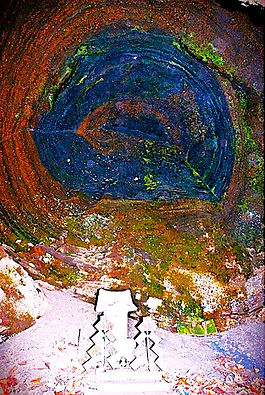
Dragon Eye that appears in Kagami-numa Pond, Hachimantai

Dragon Eye that appears in Kagami-numa Pond, Hachimantai

Dragon Eye that appears in Kagami-numa Pond, Hachimantai

Dragon Eye that appears in Kagami-numa Pond, Hachimantai

Dragon Eye that appears in Kagami-numa Pond, Hachimantai

霊山十和田は、熊野、日光、白山、出羽三山に匹敵する霊山だった!
十和田神社は、明治初年の神仏分離以前は「額田嶽熊野山十灣寺」を号する神仏習合の寺院であり、十和田青龍権現を祀り、現在の拝殿の場所に観音を本地仏として安置する仏堂「十和田御堂」が建っていました。
また、十和田神社の右奥の岩山を登った先の台地は、南祖坊が入定し青龍権現となったと伝える中湖(なかのうみ)と「カミ」の宿る御倉(おぐら)半島の「御室(おむろ)、奥の院」をのぞむ神聖な場所であり、台地を降りた中湖の水際には、参詣者が占いと祈り(散供打ち)を行う占場(オサゴ場)がありました。
その頃は、十和田湖自体が聖域であり、十和田火山外輪山の内側は本来、女人禁制の世界でした。
人々は、その全体を「十和田山」と名付け、カミの住む山の意味で「御山(おやま)」と呼んでいたのです。
外輪山への登り口は、御山に入る入り口になっており、川や滝、鳥居や神社が俗界と聖域を分ける最初の結界となっていました。そして、参詣者が長い山腹の道を登りきって最初の外輪山山頂の峠に至った時、突如、視界が開けて眼下に湖水が広がる、そこが第二の結界であり、湖を礼拝する遥拝所が置かれ、峠を下った湖畔には、最初の散供打ち場「占場」が設けられていました。
人々は、さらに湖畔の長い道をたどり、第三の結界解除川(はらいかわ、現在の神田川)でみそぎを行ったあと、林立する鳥居と杉並木の参道を通って、御山の中心「十和田御堂」に至っていたのです。
About Seiryu Gongen Nanso-no-bou
The founder of the sacred mountain Towada, the legendary monk Nansonobo (who actually existed)
About the birth of NANSO-NO-BOU
He is said to have been born in the 860s during the Jogan era at Toga Shrine in Nanbu Town as the child of Kumano Gongen.
Nansonobo, a legendary monk who is widely known, was a disciple of Gappourishi, the second abbot of Hoshozan Fugen-in Temple (formerly known as Nanasaki Eifuku-ji Temple), and is said to have studied under the monk Getsu-tai (from the age of 7 for around 10 years). He later changed his name to Nansonobo and traveled around the country, visiting the Kumano Sanzan and visiting other shrines. During this time, he transformed into a nine-headed dragon and fought with Yanotarou, the lord of Lake Towada, and banished him, after which he became the dragon god of Lake Towada, Seiryu Gongen.
Hoshozan Fugen-in Temple enshrines the statue of Nansobo, "Nansohosshi," and "has two copies of the Towadayama Shinkyoki in its collection." (For more information on Fugen-in Temple, please see the bottom of this website.)
( The 65th head priest of Shohozan Fugen-in Temple (formerly known as Nanasaki Eifuku-ji Temple), Shinada Taijun, praying in prayer)
2021.10 Interview Record: Ishiji Nakamura, CEO of NBC Entertainment, photographer, and founder and advisor of the Narasaki Shrine Preservation Association "Eternal Society"

Toga-jinja

Togajinja


宝照山 普賢院
(旧称七崎永福寺)
"Narasaki Shrine (formerly known as Narasakisan Tokurakuji Temple)" and "Hoshozan Fugenin Temple (formerly known as Narasaki Eifukuji Temple)" were the bases for NANSO-NO-BO and the ascetics who founded the sacred mountain of Towada.
「七崎観音堂」(通称七崎観音):後世になってからの寺号は「七崎山 徳楽治」と称し、明治8年に「七崎神社」と奉称されています。※以下には、明治以前までは「七崎観音堂」と表記し、明治以後については「七崎神社」と表記致します
As can be seen from the fact that the temple name of Towada Odo was "Nukaga-dake Kumano-san Towan-ji" (Nuka-dake is Mount Hakkoda ), Mount Towada as a sacred mountain was "a sacred mountain of the Kumano Shugendo sect founded on the Nukanobu side."
The founding of sacred Mount Towada by Kasobo is believed to have occurred at the end of the Heian period . The base for Kasobo and his ascetic monks' founding of sacred Mount Towada was the area around present-day Nanasaki Shrine (formerly known as Nanasakiyama Tokurakuji Temple) and Hoshozan Fugenin Temple (formerly known as Nanasaki Eifukuji Temple, which was a prayer temple for the Morioka Nanbu Domain) in Toyosaki-cho, Hachinohe City .
Nanasaki Shrine in Toyosakicho, Hachinohe City, is a "large-scale base temple and shrine for Shugendo" and is said to be "the home of the Nansobo Shugendo sect." Please see the replica below.
This is a copy of the landscape of the area around Nanasakiyama Tokurakuji Temple (now Nanasaki Shrine) that was published in the 1872 edition of the New Mutsu Kokushi, a geographical record compiled by Aomori Prefecture and submitted to the national government before the Meiji Emperor's tour. It is considered a valuable historical document that provides insight into the Edo period. It is housed in the University of Tokyo's Archives and is a transcript of the landscape that appears in the New Mutsu Kokushi, published in 1872.
In 2007, six "Buninjo" documents dating back approximately 200 years to the Edo period were discovered at Nanasaki Shrine. The "Buninjo" were issued by the Kengyo (a position that oversees the general affairs of temples and shrines) of the Kumano Sanzan (Kumano Hongu Taisha, Kumano Jingu Taisha, and Kumano Nachi), the headquarters of Shugendo. These "Buninjo" documents were written in 1813 (Bunka 10), 1838 (Tenpo 9), and 1859 (Ansei 6), respectively, and were certificates (permits) that defined the areas of responsibility of three Shugendo practitioners from Nanasaki: Zengyoin Eigen, Zengakuin Eitei, and Zenmyoin Eiryu.
The name of Tamonin, a Shugendo monk from Torai in Shingo Village, is also included, and it is known that at the time Gonohe, Shingo, and Toyosaki were part of the territory of the Morioka Nanbu domain, and so the temple was under the lineage of Shugendo monks from Morioka.

Below the worship hall of Narasaki Shrine, Shoryu Hokosugi Cultural Property

*About the image above: A replica of the scenery around Narasakiyama Tokurakuji Temple (now Narasaki Shrine) published in the 1872 edition of the "Shin Mutsu Kokushi" (New History of Mutsu Provinces) (a transcript held at the University of Tokyo Archives).
Along the "Teranaimon" street depicted in the lower part, several temples of ascetics stand in a row, revealing remnants of the site's role as a base for the Nansobo sect of ascetics that founded the sacred Towada mountain. It is a large-scale base temple and shrine for ascetics, and it is said that "the Nansobo sect of ascetics actually existed here." Zengyo-in (an ascetic temple) is located in the center right of the image, and Daikaku-in (an ascetic temple) is located on the left. The head temple, Nanasaki Eifuku-ji (now Fugen-in), is not depicted in the photo, but it is located on the right side, about 300 meters before Nanasakiyama Tokuraku-ji.
修験道とは、平城京に都があった奈良時代(710年〜794年)に成立した、日本独自の宗教で、外国にはない山岳信仰と仏教が習合した信仰です。
七崎観音堂創建後いつの時代かは定でないが、徐々に、「修験者たちの大規模な拠点寺社」が形成されていったと、推定されています。南祖坊による霊山十和田の開山は、平安時代末期とされていることから、同時期頃には、修験者の拠点とする寺社が形成されていたのではと、推定されています。
*About the image above: A replica of the scenery around Nanasakiyama Tokurakuji Temple (now Nanasaki Shrine) published in the 1872 edition of the "Shin Mutsu Kokushi" (New History of Mutsu Provinces) (a transcript held at the University of Tokyo Archives).
Along the "Teranaimon" street depicted in the lower part, several temples of ascetics stand in a row, revealing remnants of the site's role as a base for the Nansobo sect of ascetics that founded the sacred Towada mountain. It is a large-scale base temple and shrine for ascetics, and it is said that "the Nansobo sect of ascetics actually existed here." Zengyo-in (an ascetic temple) is located in the center right of the image, and Daikaku-in (an ascetic temple) is located on the left. The head temple, Nanasaki Eifuku-ji (now Fugen-in), is not depicted in the photo, but it is located on the right side, about 300 meters before Nanasakiyama Tokuraku-ji.

Nanasaki Shrine Hokuto's Thousand-Year Cedar, a designated cultural property of Hachinohe City
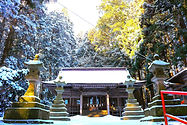
Narasaki Shrine worship hall
Narasaki Shrine worship hall

Narasaki Shrine
Shugenshiya Gyōyado (mountaineering hall)

Hoshozan Fugen-in Temple (Narasaki Eifuku-ji Temple)
Nanso-no-bo was a monk at Narasaki Eifuku-ji Temple from a young age and is considered the founder of Mount Towada. Mount Towada was the center of the "Towada faith" that has continued since the end of the Heian period, and was a sacred mountain site that was considered the largest "center of spirit faith" in the northern Tohoku region, comparable to Kumano, Nikko, and Hakusan , and where Towada Seiryu Gongen is enshrined.
Within the grounds of Narasaki Shrine, there is a Komorido hall, where ascetics are said to have purified themselves before heading to the Kumano Sanzan, the headquarters of Shugendo. It is believed that Kasobo also purified himself here before heading to the Kumano Sanzan.
In 2007, to commemorate the discovery of six "Buninjo" documents from the Edo period, approximately 200 years ago, the " Kumano Sanzan Dewa Sanzan Gyoyado" was rebuilt at Narasaki Shrine, carefully preserving the historical fact that the shrine was a large base for ascetic monks since the Heian period.
[About the head temple, Narasaki Eifuku-ji Temple (now Fugen-in Temple)]
Hoshozan Fugen-in Temple enshrines the statue of Nanso-no-bo, "Nansohosshi," and "has two copies of the Towadayama Shinkyoki" in its collection.
◆The temple name (name) of Fugen-in (formerly known as Nanasaki Eifuku-ji) in its early days is unknown. The Fugen-in death register states that Enkyo, the temple's founder (first chief priest), passed away in 817, which is the basis for the public statement that the temple was "founded around 810." Based on various theories, it has recently been stated that the temple was "founded during the Enryaku and Kōnin eras."
◆The temple's former name, "Nanasaki Eifuku-ji," was used from the Kamakura to Edo periods, and according to early modern historical documents, the name Eifuku-ji comes from "Yofuku-ji Temple" in Nikaido, Kamakura City, Kanagawa Prefecture. A monk from Yofuku-ji Temple, Yugen, was entrusted with the construction of Eifuku-ji Temple in Mito by the Nanbu clan, and was given the land of Nanasaki as a reward at that time . As a result, he was also given the management of the temple in Nanasaki, and as it was "a temple managed by the monks of Yofuku-ji Temple," the temple also eventually came to be called Eifuku-ji.
◆ Formerly known as Nanasaki Eifuku-ji, it is widely known as the prayer temple of the Nanbu domain. After the main temple, Eifuku-ji, was established in Morioka, Nanasaki Eifuku-ji (now Fugen-in) and Mito Eifuku-ji (Reisho-in) became its own temples, and although they are in remote locations, they are directly controlled temples. Eifuku-ji became the head temple of the Nanbu Morioka domain and came to have many branch temples, of which this temple is the ancestor . At one time, a priest from Ninna-ji Temple in Kyoto was appointed to the main temple, Morioka Eifuku-ji, and the temple's prestige rose significantly, and as a result, the temple's origins and history were revised to reflect this .
*Ninnaji Temple is the head temple of the Omuro school of Shingon Buddhism, located in Omuro-Ouchi, Ukyo Ward, Kyoto City. The temple's name is Ouchiyama. The principal image of the temple is Amida Nyorai. It was founded by Emperor Uda. It is registered as a World Heritage Site as part of the "Cultural Monuments of Ancient Kyoto."
( The 65th head priest of Shohozan Fugen-in Temple (formerly known as Narasaki Eifuku-ji Temple), Shinata Taishun, praying in prayer)
2021.10 Interview Record: Ishiji Nakamura, CEO of NBC Entertainment, photographer, and founder and advisor of the Narasaki Shrine Preservation Association "Eternal Society"
What is Shugendo of the Shugendo practitioners?
Mount Towada is a pure land far removed from the secular world, a deep mountain range and lake filled with the spiritual power of nature, and a sacred place opened as a place for Buddhists and ascetics to carry out mountain training. "Training grounds" for Shugendo were set up in various places.
Shugendo aims to train the mind and body by placing oneself in harsh natural environments and attaining enlightenment. Shugendo is a religion unique to Japan, a syncretism of mountain worship and Buddhism not found in other countries, and is a religion that aims to gain supernatural powers and save the world by venturing into sacred mountains and deep, secluded valleys and undergoing rigorous training. And because of the way they practiced by prostrating themselves in the mountains, they were called "yamabushi."
The three elements of swordsmen
-
Isolation from the mundane world (secret location)
It is essential that the environment be one where one can concentrate on one's training, away from the hustle and bustle and temptations of the world. Remote locations such as deep mountains or valleys, and places that are difficult to access, are chosen. -
Harsh Natural Environments Shugendo aims to train the mind and body and attain enlightenment by placing oneself in harsh natural environments. For this reason, places that involve physical pain, such as bitterly cold waterfall basins or dark, humid caves, are suitable.
-
A sacred place (religious significance)
It is not just the physical harshness that is important; the land is also a sacred place in the history of mountain worship and Shinto-Buddhist syncretism. Practitioners regard nature itself as a manifestation of gods and Buddhas, and approach their training with awe.
Shugendo was established during the Nara period (710-794), when the capital was Heijo-kyo, and was founded by a sorcerer named En no Ozuno, also known as En no Gyoja. The En clan was a large clan that existed in Yamato and Kawachi provinces at the time, and En no Ozuno is believed to have been a real person. However, the image of him as the founder of Shugendo is thought to have been created later. En no Ozuno was born in 634 in what is now Gose City, Nara Prefecture, and today Yoshishojoji Temple has been built there to celebrate his achievements.
The second lord of the Morioka Nanbu domain, Nanbu Toshinao, and his belief in Towada and the protection of the sacred mountain, Towada
"Protecting Towada, the Sacred Mountain of Nanbu Toshinao"
Lake Towada was once known as Kami no Yama or "Miyama" and was one of the most sacred mountains and mountain sacred sites in the Tohoku region. Its founding dates back to the end of the Heian period, and during the Edo period it was protected by Toshinao of the Morioka Nanbu domain, and has a history of being a very prosperous place.
Nanbu Toshinao was a feudal lord from the Azuchi-Momoyama period to the early Edo period, and the first lord of the Morioka Domain in Mutsu Province. He held the rank of Junior Fourth Rank, Lower Grade, and Shinano no Kami. He was the 27th head of the Nanbu clan (the second head of the Morioka Nanbu clan) and a devout Towada believer. He claimed to be the reincarnation of Nanso-no-bo, and is said to have taken the posthumous Buddhist name "Nanshuin Geskei Seiko."


Morioka Shoten Eifukuji Temple
Regarding Toshinao, who claimed to be the reincarnation of Nanso-no-bo and adopted the posthumous Buddhist name "Nansoin Gekkei Seiko," the " Yusei Shiki " tells the story of how "when Toshinao Nanbu was sleeping, he saw him as a snake," and then goes on to say, "Nansobo appeared in Toshinao Nanbu's dream and told him that he had been reborn as you in order to avoid becoming a snake." When Toshinao told this to his followers, many believed it to be true.
When Toshinao died in Edo during the Kan'ei era, it is said that both Daiei Osho of Tozenji Temple in his hometown and Konchiin Temple in Edo chose the same title, "Nanshuin-dono," even though neither had any knowledge of the dream and had never consulted the other.
This clearly shows that Toshinao was the reincarnation of Nansobo, and it is written that "when Toshinao's funeral was held in Sannohe, the sky suddenly became cloudy and there was heavy rain, lightning and thunder."
The place name "Morioka" is said to have been established as "Morioka" in June 1691 (Genroku 4) through a linked poem by Nanbu Shigenobu and Seisan Hoin, the head priest of Morioka Eifuku-ji Temple. Eifuku-ji Temples in Sannohe and Toyosaki were merged into Morioka, and Eifuku-ji Temple in Morioka was given the mountain name "Hoju Morioka-san." It is the head of the Morioka Five Mountains and has been a temple of prayer for generations of the domain. It is said that Seiryu Daigongen-do Hall was located on the banks of Ryujin Pond.
The second lord of the Morioka Nanbu domain, Nanbu Toshinao, and his belief in Towada and the protection of the sacred mountain, Towada
The Morioka domain protected Juwanji Temple, located in Yasumiya, Lake Towada , from outside forces, and did not allow other forces that did not practice Kumano-style asceticism to approach the area around Lake Towada, so it is said that the Dewa mountain ascetics had no choice but to make their pilgrimage from the faraway Mount Ohanabe and then return.
Kuriyama Shinbei, who first developed Yasumiya in the early Meiji period , had the primary objective of developing a military farm to guard the border with the Hirosaki Domain , which was on bad terms with the Morioka Domain. During the Edo period, worshippers at Juwanji Temple mainly came from all over the Morioka Domain, but it is said that there were also worshippers from the Hachinohe Domain and as far away as the Sendai Domain . However, there are no records of worshippers from the Hirosaki or Akita Domains .
[ Early Modern Towada Pilgrimage Route ]
The monument in Nenokuchi commemorates the construction of the "Towadayama New Road," a monument commemorating the renovation of the Gonohe and Shichinohe pilgrimage routes to Lake Towada in 1693. During the Edo period, there were five main pilgrimage routes leading to Lake Towada.
-
Gonoheguchi Trail - Starting from the medieval Nanasaki Eifuku-ji Temple in Gonohe Narasaki (present-day Toyosaki Town), which was the base of Kasobo, the founder of the sacred mountain Towada, the Gonoheguchi Trail climbs a long mountain path from Tsukihiyama, at the eastern end of the outer rim of the volcano, and offers distant worship of Lake Towada from the summit of the volcano above Choshi Otaki Falls, passing Choshi Otaki Falls and Utarube before arriving at the Mido hall.
-
Shichinoheguchi Road - The Shichinoheguchi Road starts in Okuse, Kamikita District (present-day Okuse, Towada City) and joins the Gonoheguchi Road in Sobe.
-
Sannoheguchi Road - The Sannoheguchi Road started from Kaimori, Sannohe County (present-day Kaimori , Sannohe Town ).
-
Shirasawa Road - The Shirasawa Road starts from Kemanai and passes through Oyu, Shirasawa, and Hakko Pass (a remote worship site) before reaching the temple.
-
Fujiwara Road - The Fujiwara Road starts from Kemanai and passes through Nanataki, Namidayama Pass (a remote worship site), and joins the Shirasawa Road at the current Oide Campsite below Hatsuha Pass.
The Nanbu clan also had a strong faith in Towada, and it is said that the Gonohe magistrate visited the shrine on behalf of the clan lord at the annual festival of Towada Mido on May 15th.
The Towada pilgrimage route and the cedar trees lining the Yasumiya approach were also maintained by the feudal domain, and pilgrimages to Towada by the general public reached their peak during the Edo period, the ban on women being lifted, and it is said that hundreds of men and women visited the annual festival held on May 15th (in the lunar calendar), after the rice planting season. In 1681 (the 9th year of the Enpo era), a new hall was built with private support, and stone lanterns and stone signposts donated by the people of the villages were made along the pilgrimage route and remain to this day.
The Morioka domain protected Juwanji Temple, located in Yasumiya, Lake Towada , from outside forces, and did not allow other forces that did not practice Kumano-style asceticism to approach the area around Lake Towada, so it is said that the Dewa mountain ascetics had no choice but to make their pilgrimage from the faraway Mount Ohanabe and then return.
Kuriyama Shinbei, who first developed Yasumiya in the early Meiji period , had the primary objective of developing a military farm to guard the border with the Hirosaki Domain , which was on bad terms with the Morioka Domain. During the Edo period, worshippers at Juwanji Temple mainly came from all over the Morioka Domain, but it is said that there were also worshippers from the Hachinohe Domain and as far away as the Sendai Domain . However, there are no records of worshippers from the Hirosaki or Akita Domains .
[ Early Modern Towada Pilgrimage Route ]
The monument in Nenokuchi commemorates the construction of the "Towadayama New Road," a monument commemorating the renovation of the Gonohe and Shichinohe pilgrimage routes to Lake Towada in 1693. During the Edo period, there were five main pilgrimage routes leading to Lake Towada.
-
Gonoheguchi Trail - Starting from the medieval Nanasaki Eifuku-ji Temple in Gonohe Narasaki (present-day Toyosaki Town), which was the base of Kasobo, the founder of the sacred mountain Towada, the Gonoheguchi Trail climbs a long mountain path from Tsukihiyama, at the eastern end of the outer rim of the volcano, and offers distant worship of Lake Towada from the summit of the volcano above Choshi Otaki Falls, passing Choshi Otaki Falls and Utarube before arriving at the Mido hall.
-
Shichinoheguchi Road - The Shichinoheguchi Road starts in Okuse, Kamikita District (present-day Okuse, Towada City) and joins the Gonoheguchi Road in Sobe.
-
Sannoheguchi Road - The Sannoheguchi Road started from Kaimori, Sannohe County (present-day Kaimori , Sannohe Town ).
-
Shirasawa Road - The Shirasawa Road starts from Kemanai and passes through Oyu, Shirasawa, and Hakko Pass (a remote worship site) before reaching the temple.
-
Fujiwara Road - The Fujiwara Road starts from Kemanai and passes through Nanataki, Namidayama Pass (a remote worship site), and joins the Shirasawa Road at the current Oide Campsite below Hatsuha Pass.
What is the oldest original "Lake Towada legend"?
Among the many legends about the dragon god, the oldest, known as the "Lake Towada Engi," is the "Sangokudenki," a book containing 360 stories (a collection of biographies compiled by monks from India, China, and Japan).
The story in Volume 12, Chapter 12, entitled "Shaku Nanzo (Nansobo) Attains Immortality and No Birth" is said to be the oldest origin of the "Lake Towada Dragon God Legend." The story "Shaku Nanzo Attains Immortality and No Birth" from the collection of stories "Sankokudenki" by the Tendai monk Gento in the early 15th century is as follows:
The story of Hachirotaro, which is handed down in the "Lake Towada Legend," and the "Three Lakes Legend" are not included. In fact, the "Nasobou Story" and the "Hachirotaro Story" were originally separate tales.
The story told around Lake Towada was the story of Kasobo (also known as Nanzo or Kasobo), while the story of Hachirotaro was told in areas such as Kazuno and the Yoneshiro River basin, around Lake Hachirogata, the Nukabe region, and the Kitakami River basin. These stories were combined into one tale in the latter half of the Edo period.


「玄棟(げんとう)」による説話集
「三国伝記」第巻十二第十二話「釈難蔵(南祖坊)得不生不滅事」と 題する説話
「本編」
昔、播磨国書写山に釈難蔵(僧難蔵=何祖坊)という法華経の行者がいた。
生きている間に、弥勒菩薩(みろくぼさつ)がこの世にあらわれる「弥勒の出世」に会いたいと願い、
熊野山に三年間参籠(さんろう)し、千日目の夜、「前世の宿縁によって現世で出会うことができるであろう」と、
夢告がり、神のお告げを得る。
それに従い『陸奥と出羽の境」にある「言両の山/ことわけのやま」(修験者の立ち入る霊山、十和田湖をさす)の頂にある大きな池に行き、池の畔で読経に励んだ。
すると、
年のころ十八、九の池の主でる女が毎日聴聞にあらわれ、仏に結縁したいと願う。
女は「私の住処に来て衆生のために法華を読誦して欲しい」という。
難蔵が「私はここで弥勒の出世を待っているのだから、よそには 行けない」と断ると、
女は「私はこの池の主の龍女です」。
龍は、一生の間に千仏の出世に会うほどの長命な生き物、私と夫婦になって弥勒の下生を待ってはいかが」という。難蔵はなるほどと思案をめぐらし、龍女とともに池に住むことにした。
ところが龍女から、
「自分は月の半分を言両山の池で暮らす奴可の嶽(ぬかのだけ/八甲田山)の八つの頭の大蛇の妻にされ、
困っている」と、打ち明けられる。
難蔵は少しも怯まず、法華経八巻を頭上に置いた。
すると、
難蔵の姿はたちまち九頭竜と変じ九つの頭の龍となり、八つの頭の大蛇と七日七夜にわたって激闘。
ついに八頭の大蛇が負けて大海に入ろうとしたが、
大きな松(蛇王の松/じゃおうのまつ)が邪魔をしたため、
威勢も尽きて小蛇となり、何処かの池に、逃げ帰った。
龍となった難蔵は、龍女と夫婦となって暮らし
今でも、山人が池の畔に至ると、激しい浪の下から法華経を読む声が聞こえるという。
This is the "oldest original legend of Lake Towada," which says that Kasobo was the reincarnation of Sho Kannon, who transformed Lake Towada, which was ruled by an eight-headed giant serpent that lived in a pond at Nukanodake (present-day Mount Hakkoda), into a peaceful and calm "Sea of Buddhas," married a dragon girl of Lake Towada who was tormented by the giant serpent, and then became the Seiryu Gongen himself and became the lord of the lake.
In the Legend of Lake Towada and the Legend of the Three Lakes, Nanso-no-bo is the main character, and Hachirotaro is a violent giant snake who torments people. However, as these were later changed into coming-of-age stories with the young Hachirotaro as the main character, Nansobo was relegated to a supporting role and a villain.
*Please refer to "Memories of the Blue Sky" and other works such as Toshio Saito's "Sacred Mountain Towada: Another Forgotten Lake Towada."
It calms doubts, gives courage, and brings good fortune and luck!
The blessings of Tensho Towada Seiryu Gongen

![IMG_0078[1].jpg](https://static.wixstatic.com/media/581327_c8f4d4fef77c49a08695cac7702936c2~mv2.jpg/v1/fill/w_340,h_227,al_c,q_80,usm_0.66_1.00_0.01,enc_avif,quality_auto/581327_c8f4d4fef77c49a08695cac7702936c2~mv2.jpg)
The "heavenly light" illuminating Okuno
in/Omuro on the Ogura Peninsula
’撮影:写真作家ジェイスン中村

Lotus Sutra

If you have any problems, don't give up and be sure to come and see us !
you r
br a n d
When you have a problem, don't give up and be sure to come and see us!
修験道の拠点だった七崎山 徳楽寺(八戸市豊崎町)から、遥か、熊野へとたどり着き、「生きている間に、弥勒菩薩(みろくぼさつ)がこの世に現れる”弥勒の出世”に会いたい!」と願い、一心に、修業に身を投じ励んだ南祖坊。やがて、千日目に、神の夢告に導かれ、霊山十和田の開山の【上人】となります。
南祖坊が「行場」として選んだ、御倉半島の洞窟に籠り、「蓮華經」を、一念に、唱え続けたその信念は、遂に、天に届き天を動かし、行場とした神聖な「御室」の頑丈な岩盤さえ貫き、天が、南祖坊に「青龍権現」を授け、その証として、ご神体の化身とする「龍の目」を岩盤に刻まれたのだと、伝承されています。
天は、厳しい行場に身を投じ一心に唱える「南祖坊」を受け入れ、そのご神体の化身として、最も神聖な御室の岩盤に、「龍の目」を刻み、「青龍権現を授けた」とされています。
何祖坊の一念は、「天を貫き、天を動かし、天が授けた青龍権現」とされています。
訪れる、ご参拝者の苦行苦難に寄り添い、困難に立ち向かう勇気と、人々の心の迷いを悟り鎮め、勇気を与え前進へと導き、「開運と幸運を授ける青龍権現」とされています。
※蓮華經は大乗仏教の重要な経典であり、多くの信者に影響を与え続けています。その教えは、すべての生き物が成仏できるという思想を強調しており、その教えを実践することで、成仏の道を歩むことができると説いています。
The blessings of Tensho Towada Seiryu Gongen
-
Matchmaking: Nansobo is said to have the power to bring about love.
-
Wish fulfillment : He Zu Fang is said to have the power to grant any wish.
-
Good luck : It is said to bring good luck and fortune.
-
God of Water : As a dragon god, he is said to bring the blessings of water and the power of all purification.
-
Courage and progress : It is said to give you the courage to face difficulties and the power to calm your inner confusion .
その他、青龍権現の化身の象徴は、以下のような重要な意味を持っています:
-
パワーや新しい生命の再生を象徴し、自然と宇宙の調和を表す存在です。
-
東方を守護し、春の象徴として、成長や発展の力を帯びています。
-
学問や学びの守護として、知恵を開く象徴とされ、新たな挑戦をサポートします。
-
農業の神としても崇められ、農作物の成長を助けます。