

The "guardian deity" of Towada-Hachimantai National Park

北奥最大のパワースポット
十和田八幡平国立公園の聖地へようこそ

A group of sculptures that embodies the soul of a shrine carver who speaks to and connects with wood
A play performed by the skills of artisans
Main shrine of the main deity "Yamato Takeru"
The hero Yamato Takeru no Mikoto, who appears in the Kojiki and Nihon Shoki, is said to have transformed his soul into a swan and flown off towards Yamato.

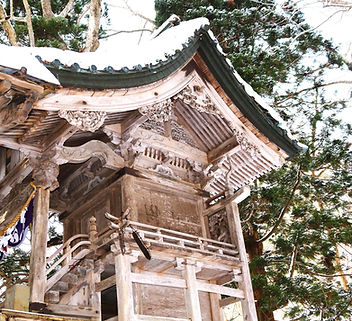
Main shrine


Left exterior corridor sculpture

Main shrine

Right exterior corridor sculpture
Affiliated shrines

Inari Shrine

Kumano Shrine

Lotus Sutra

Torii 123

手水舎


The mysterious lake where the Azure Dragon resides
Ommaegahamma
Okunoin on the Ogura Peninsula is where Seiryu Gongen (Nansonobo) is enshrined. The divination site is a sacred place where Nansonobo is said to have entered nirvana in Lake Towada. Facing the mountain where the gods reside, "Mt. Ogura," and the inner sanctuary, "Omuro," worshippers prayed and performed sanguuchi (scattering offerings). Sanguuchi is a form of divination in which coins or rice are wrapped in paper, prayed to the gods, and thrown into the lake.

To Shinsen
To Shinsen
神泉宛は御倉半島を望む山頂の台地にあり、南祖坊が一念に「法華経」を唱え天に祈りを捧げた神聖な行場の一つです。【南祖坊尊像を祀る祠】と【十和田青龍大権現社】が鎮座します。神泉苑の断崖絶壁を40m程下った所が、南祖坊が、十和田湖に入定し十和田青龍大権現となったとされる「オサゴ場/占場」です。
![IMG_1106[1].jpg](https://static.wixstatic.com/media/581327_7939acd8ab3841d2b74b39d2d0d82575~mv2.jpg/v1/fill/w_717,h_1076,al_c,q_85,usm_0.66_1.00_0.01,enc_avif,quality_auto/581327_7939acd8ab3841d2b74b39d2d0d82575~mv2.jpg)

Explanation of the fortune-telling place
Praying at Osagoba towards Omuro (inner sanctuary) is the true form of worship.
十和田神社の右奥を下ると「神泉苑」の山頂へ登る階段があります。(左画像)。登った先の台地「神泉苑」は、中湖(なかうみ)と、「カミ」の宿る御倉半島の「御室(奥院)」を望む場所で、南祖坊が、一心に、祈りをささげた場所でもあります。南祖坊を祀る祠と、十和田青龍大権現社が鎮座します。
「神泉苑」を下った中湖の水際は、南祖坊が入定し青龍権現になったと伝わる神聖な場所で、参詣者が、散供打ち(占いと祈り)を行う「オサゴ場(占場)」があります。占場に至るには落石もあり大人でも非常に危険な為、残念ですが、現在は、入場できません。
平安時代後期より、参詣者はカミの宿る山「御倉山」に向かい、南祖坊が鎮座する奥院「御室」を正面に、拝みながら散供打ちを行ってきました。御倉半島奥院「十和田青龍大権現/南祖坊」へご祈願することこそが、参詣(信仰)の目的だったとされています。
現在は、「御前ヶ浜(乙女の像の前)」でも、「オサゴ場(占場)」同様の効果があることから、散供打ちにお越し頂いた皆様は「御前ヶ浜」にて、「散供打ち(占いと祈り)」をご作法ください。
※散供打ちとは、銭や米を紙に包み、神に祈って湖中にそれを投じる占いで、「オサゴ場」とは「御散供場(おさんぐば)」がなまったものです。お申し込みは、拝殿前の「授与所」で承っております。
※オサゴ場前の湖底からは1903年から4回の引き上げ作業で、中国銭や朝鮮銭、寛永通宝など古銭約3000枚と銅鏡や剣が発見されています。


神泉宛へ至る階段

Seiryu Gongen Shrine

Shinsenen

Seiryu Gongen Shrine
To Shinsen


Shinsenen

Seiryu Gongen Shrine
To Shinsen

占場から望む最も神聖な御倉半島に鎮座する「十和田青龍大権現」御室/奥院
Okunoin on the Mikura Peninsula is where Seiryu Gongen (Nansobo) is enshrined. The divination site is a sacred place where Nansobo is said to have entered nirvana in Lake Towada. Facing the mountain where the gods reside, "Mt. Mikura," and the inner sanctuary, "Omuro," worshippers prayed and performed sanguuchi (scattering offerings). Sanguuchi is a form of divination in which coins or rice are wrapped in paper, prayed to the gods, and thrown into the lake.
![IMG_2379[1]御倉半島.jpg](https://static.wixstatic.com/media/581327_bf2d9afd1e78403b8fe6f7bab88dd5e2~mv2.jpg/v1/fill/w_759,h_506,al_c,q_85,usm_0.66_1.00_0.01,enc_avif,quality_auto/581327_bf2d9afd1e78403b8fe6f7bab88dd5e2~mv2.jpg)

占場から望む「奥院/御室」

十和田神社占場

十和田神社占場

占場「杉のご神木」

神泉宛から占場
へ降りる鉄の梯子

「南祖坊」が十和田湖に入定したとされる神聖な場所
神聖な占場での散供打
【占場(オサゴ場)】

ここは古来より龍神信仰の霊験あらたかな所であって人智、人力の及ばない処を御神力によって世の安泰を祈る所である。されば昔から社参のともがら此所に来って、至心に一切のことを占い求めました。
万一うけひき給わぬ時は、いずこよりか深山鴉飛び来て、占い紙をくわえ去ったと語られて居ります。想いを込めて占問うものは何ぞ。
すなわち、年穀の豊区、海漁の予測をはじめ、事業将来の成不成、病気本復の速不速、交通安全、念願の成否、嗣子の有無あらゆることを占トして神意心当、まことに畏るべくまた敬すべく秘奥の旧儀なのであります。

Kafujima Island, where Ebisu and Daikokuten are enshrined
Kafujima Island lies at the end of Gozengahama Beach. Shrines dedicated to Ebisu and Daikokuten stand on top of it. Gozengahama means the beach in front of the gods , and is where the maiden statue stands. The white sand beach is dotted with Yoroijima, Kabutojima, Ebisujima, and Daikokujima, and is surrounded by clusters of pine trees. Ebisujima and Daikokujima are two islands located very close to the beach, a short distance apart. Pilgrims were said to be granted "good fortune" if they threw coins into the islands, and so these two islands are collectively called "Kafujima." Old coins washed up on the beach tell the story of the time when this sacred mountain site was bustling with pilgrims from the late Heian period onwards.
Path of Good Fortune
Along the path leading from the shrine grounds to Gozengahama Beach, there are many caves where gods such as the "God of Fire," "God of the Mountain," and "God of the Wind" are enshrined.

Sun God

The mysterious lake where the Azure Dragon resides

Amanoiwato
Mount Towada is a pure land far removed from the secular world, a deep mountain range and lake filled with the spiritual power of nature, and a sacred place opened as a place for Buddhists and ascetics to carry out mountain training. Training grounds for Shugendo were set up in various places.
Shugendo aims to train the mind and body and attain enlightenment by deliberately placing oneself in a harsh natural environment.
It is a religion unique to Japan, a syncretism of mountain worship and Buddhism that is not found in other countries, and it is a religion that aims to gain supernatural powers and save the world by venturing into sacred mountains and deep, secluded valleys and undergoing rigorous training.These people were called "Yamabushi" because of the way they practiced by prostrating themselves in the mountains.
Therefore, places that involved physical pain, such as cold waterfall pools or dark, humid caves, were suitable for them.
Thus, the places that were used as training grounds for training the mind and body and attaining enlightenment remain as the Heritage of Sacred Mount Towada: the caves that were used as training grounds and are scattered along the Path of Good Fortune, where the gods of wind, fire, gold, Ama-no-Iwato, and sun are enshrined.

Golden God

Mountain God
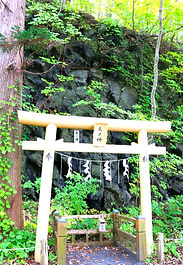
God of Fire

風ノ神
*There is also what appears to be a cave on the other side of the cliff, and it is believed that there was once a training ground surrounding Gozengahama.
Path of Good Fortune
鳥居をくぐり本殿へのアプローチの小道には、大杉の巨木をはじめ多彩なご神木が鎮座します。苔が生えた岩を割り根ざすご神木の姿は、圧巻です。手水舎の前に鎮座する人間の姿に似たご神木「女木」を、ご覧ください。

大地に根ざす二本の足、こんもりと膨らんだお腹、樹形が妊婦を思わせることから、古来より「子宝・安産・女性の無病息災」にご利益があるとされるご神木【女木】。

ご神木「女木(めぎ)」
古来より「子宝・安産・女性の無病息災」にご利益があるとされるご神木【女木】。
